Almost Famous
Cameron Crowe's "Love Letter to Music" Celebrates an Anniversary

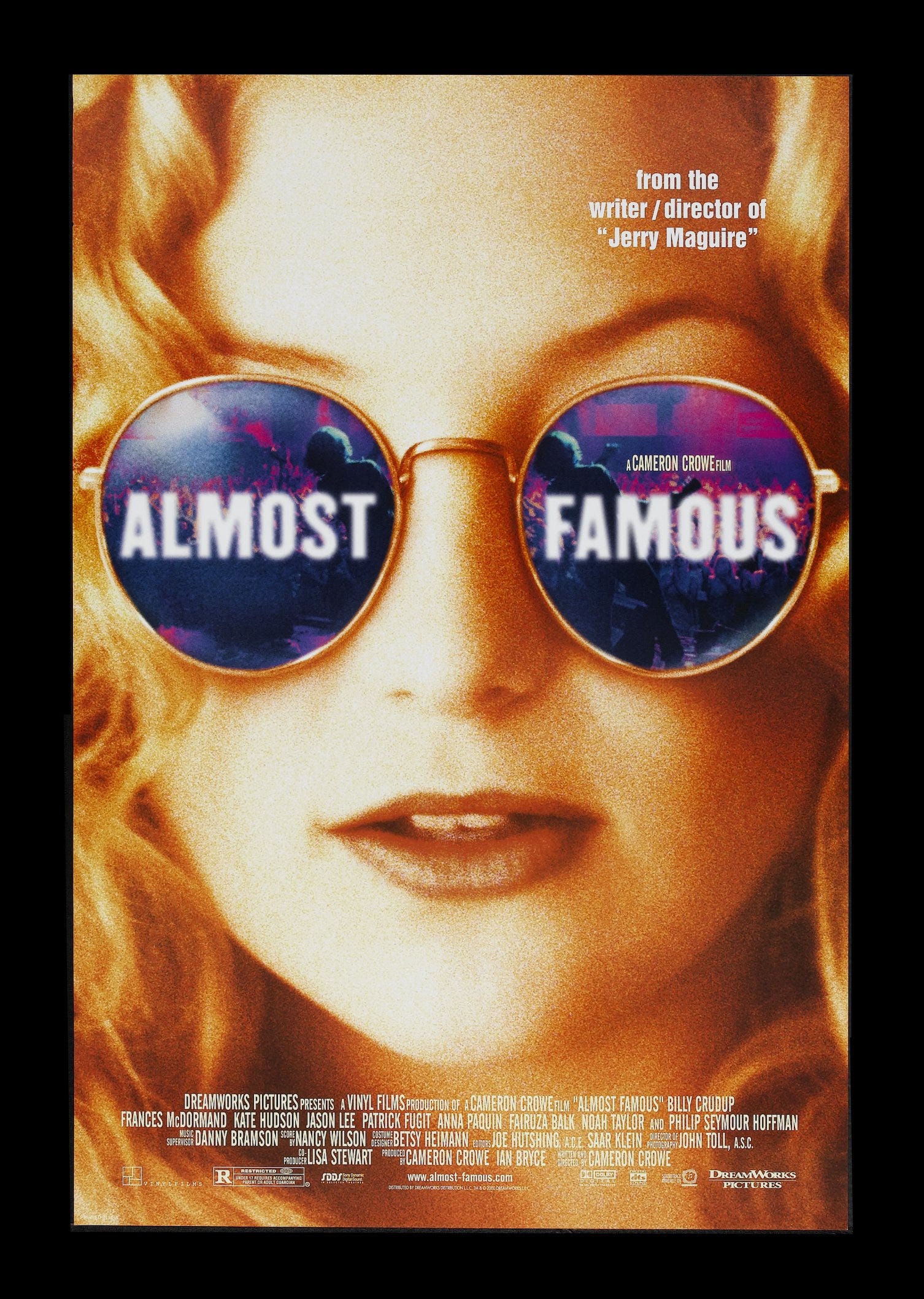
Twenty-five years ago, director Cameron Crowe released his semi-autobiographical film, Almost Famous. It was inspired by his experiences in the early seventies writing about rock and roll for Creem and Rolling Stone magazines. The film captures the experience of a young journalist, fresh out of high school, attempting to write an article about a band on the verge of stardom. Along the journey, he meets groupies (or Band-Aids as they prefer to be called), self-centered rock stars, and acerbic band managers, as he tries to be taken seriously by more experienced music journalists.
Full disclosure, I love this movie! The main character, William Miller, graduates from high school in 1972 (the same year I graduated) and has the same fascination for early seventies rock and roll that I did (and still do).
In real life, Crowe was considered by his parents to be gifted. They routinely had him skip grades to the point where he graduated high school (also in 1972) at age 15. He was decidedly uncool in his surfer-culture San Diego hometown. Crowe began writing for the school newspaper at 13 and communicating with legendary rock music critic Lester Bangs. (This period is depicted in the film quite literally)
The movie was inspired by Crowe’s first cover story about the Allman Brothers Band following the death of their leader and guitarist, Duane Allman. “I was 16 when Rolling Stone sent me out on the road with the Allman Brothers Band,” said Crowe in 2000.
In a pivotal early scene, he meets his mentor Bangs, who tells him: “You got an honest face. They’re gonna tell you everything. But you CANNOT make friends with the rock stars.” But William IS a fan and pursues his craft with a conflicting mix of serious journalism and fandom. The movie substitutes the Allman Brothers with a fictitious band, Stillwater.
As an aside, the concert scenes featuring Stillwater are so effective and realistic, I thought they were a real band. It turns out two of the members were musicians, and Peter Frampton taught lead guitarist Russell Hammond (Billy Crudup) how to act and play like a guitarist. To further the illusion, they recorded additional songs and even a music video for home video versions.
The film explores the hedonistic and sexist world of 70s rock. In one scene, Stillwater plays poker with members of Humble Pie. The winner gets the three groupies (Band-Aids) that had been touring with Stillwater.
In another scene, there’s a real-life inspiration. Gregg Allman related a story when Crowe was touring with them that his brother Duane (lead guitarist of the Allman Brothers who died at the age of 24 in 1971) would often jump into a pool from the third floor of a Travelodge motel. Crowe used that story in a scene where fictional lead guitarist, Hammond, invited to a house party during the tour, jumps from a garage roof into a swimming pool.
Perhaps the most engaging conversations are between William and Lester Bangs (played to perfection by Philip Seymour Hoffman). Bangs is a seasoned and crusty rock music critic who sees something in William and his naivete. “I’m telling you, you’re coming along at a very dangerous time for rock and roll,” Bangs tells William in one of their meetings. He warns William not to become friends with the musicians: “These are people that want you to write sanctimonious stories about the genius of rock stars… and they will ruin rock and roll and strangle everything we love about it.”
Bangs sees in William a reflection of himself, and delivers the film’s best line: “The only true currency in this bankrupt world is what you share with someone else when you are uncool.” Their exchanges go to the heart of Crowe’s real-life struggle to write scrupulously about musicians he admired. When asked by Salon Magazine at the time of the movie’s release, how close Almost Famous was to real-life, he admitted: “Agonizingly close. Painfully close. It’s too close to even cop to, you know? But I can’t be the coy guy who says, “Don’t confuse me with the protagonist.” I can’t. It’s mostly all true. It happened.”
There are so many wonderful scenes in this film. One of my favorites and critical to William’s coming of age is just after his older sister, Anita, has an argument with her mom, who hates her daughter’s obsession with rock music. She decides to leave home with her boyfriend, and before she departs, plays a song for William and her mother to explain her decision: “America” by Simon and Garfunkel. Anita then whispers to William, “Look under your bed,” she tells him. “It will set you free.” William reaches under the bed and pulls out a stack of albums. He reverently flips through each album… Pet Sounds by the Beach Boys, Led Zeppelin II, Axis: Bold as Love by Jimi Hendrix, Bob Dylan’s Blonde on Blonde, and Joni Mitchell’s Blue, and more. William finally lands on The Who’s Tommy. Inside, he finds a message: “Listen to Tommy with a candle burning, and you will see your entire future.”
Crowe was said to have arranged the albums’ order multiple times while shooting that scene. That era’s music was so important to him that he knew this would be a statement. Crowe lovingly placed each album in that stack, knowing full well his choices as both a fan and critic would be judged.
Another pivotal scene plays out on the tour bus just after Hammond’s drug-fueled binge at the house party. Everyone is sullen, angry at Hammond, and burnt out from all the drama. Elton John’s “Tiny Dancer” begins playing in the background when, one by one, each person begins to sing along. The tenderness of this song reunites everyone – a metaphor for the healing power of music.
Throughout the film, William is consistently rebuffed in his attempts to interview Russell Hammond for his magazine article (Inspired by Crowe’s many attempts to get an interview with Led Zeppelin’s Jimmy Page). When he finally gets his opportunity in his own childhood bedroom, William presses RECORD on his tape deck and asks the question: “Russell, what do you love about music?” Russell responds: “Well, first of all, everything!”
At at time when the music industry was becoming increasingly cynical, Crowe’s “love letter to music” makes a contradictory statement that musicians, critics, and we, the fans, are all in it for the same thing: the music.
References:
https://www.shmoop.com/study-guides/almost-famous/anitas-record-collection-symbol.html
https://www.salon.com/2000/09/06/crowe/
Very interesting Pete
I love the movie too. Another great article!