Blood on the Tracks
50 years later, it still resonates as Dylan’s most honest record.

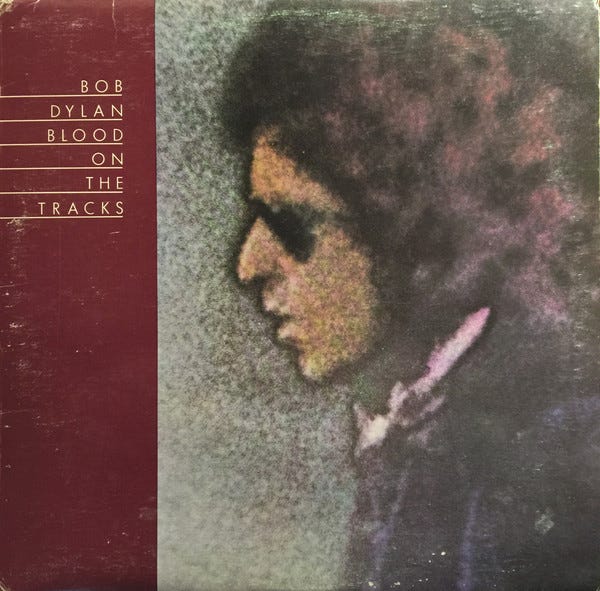
In January of 1975, when we placed Dylan’s new album on the turntable, we heard something unexpected. Produced sparingly much like his early 60s era sound with acoustic guitars, bass, and harmonica; but unlike earlier work, it was Dylan at his most fragile, most honest, and most confessional. The lyrics we heard were unlike the kiss-off, mean-spirited language of “Positively 4th Street,” “Like a Rolling Stone,” or “Don’t Think Twice, It’s Alright.” This felt like something new.
In a radio interview just months after its release, Dylan told Mary Travers (Peter, Paul and Mary): "A lot of people tell me they enjoy that album. It's hard for me to relate to that. I mean ... people enjoying that type of pain, you know?" Dylan's son Jakob has stated that the songs from Blood on the Tracks are "his parents talking."
And yet, Dylan being Dylan the enigma, later said in his memoir Chronicles, Vol 1 that the songs have nothing to do with his personal life - they were inspired by the short stories of Anton Checkhov.
Just after the famed Newport Folk Festival in 1965 when Dylan “went electric” for the first time, he quietly married Sara Lownds and moved to upstate New York. Dylan’s world tour in 1966 would feature members of the Hawks who would later become The Band. At the Manchester UK show, a fan famously shouted “Judas!” to Dylan when he launched into the electrified “Like a Rolling Stone,” prompting Dylan to shout to his band, “Play it fuckin’ loud!”
With the near-constant heckling of fans angry at Dylan for going electric, followed by a motorcycle accident in the Summer of ’66, he retired from touring and lived a mostly domestic life with his family in Woodstock NY for the next 7 years. Around 1973, he purchased land in Malibu, California and began building a mansion. Dylan started meeting with Robbie Robertson of The Band who had also moved to Malibu. They recorded what would become Before the Flood and in 1974 decided to tour together. By this time, The Band had become hugely popular as evidenced by the historic Summer Jam at Watkins Glen. It was attended by over 600,000 people (still considered the largest audience ever for a rock show) and featured only 3 acts: Allman Brothers Band, Grateful Dead, and The Band.
Dylan’s idyllic life with Sara began to unravel during the construction of the mansion and his return to touring. He had also begun taking painting lessons at the time. Dylan credits his painting teacher, Norman Raeben, for his new outlook on songwriting: “I was convinced I wasn’t going to do anything else, and I had the good fortune to meet a man in New York City who taught me how to see. He put my mind and my hand and my eye together in a way that allowed me to do consciously what I unconsciously felt,” Dylan explained to Rolling Stone Magazine about working with Raeben.
Dylan credits his teacher for transforming his understanding of time. "What's different about it is that there's a code in the lyrics, and there's also no sense of time. There's no respect for it. You've got yesterday, today, and tomorrow all in the same room, and there's very little you can't imagine not happening."
Dylan is quoted in the 1987 book, Written in My Soul: Conversations with Rock’s Great Songwriters: “I was trying to be somebody in the present time while conjuring up a lot of past images. I was trying to do it in a conscious way.”
In the summer of 1974, he returned to his home state of Minnesota to live with his brother on a farm where he wrote most of the songs for Blood on the Tracks.
Beginning with the very first track, this newfound juxtaposition of time and place is evident. “Tangled Up in Blue” follows a wanderer who appears in various locations, first “heading out for the east coast,” then to the “great north woods,” then finally to New Orleans. One lyric could relate to meeting his wife, Sara, who was married to a man named Hans when they met for the first time:
She was married when we first met
Soon to be divorced
I helped her out of a jam, I guess
But I used a little too much force
At the time of its release, we only had the album cover to find any information about the production, the backing musicians, etc. What’s listed on the back cover turns out to be inaccurate. Dylan recorded the songs in four sessions at New York’s A & R Recording Studios with producer Phil Ramone. But then he brought a test pressing of the album to his brother, David Zimmerman. David convinced Bob to rerecord five of the songs at Sound 80 in Minneapolis with local musicians (including Peter Ostroushko). His brother goes uncredited for producing half of the album.
Each track opens a new window into Dylan’s psyche at the time. The next to last song, “Shelter from the Storm,” emerges slowly with a lone acoustic guitar strumming the melody, followed by simple bass lines until the narrator begins another time warp:
'Twas in another lifetime one of toil and blood
When blackness was a virtue, the road was full of mud
I came in from the wilderness a creature void of form
"Come in," she said
"I'll give you shelter from the storm"
The ”she” who offers refuge after every verse could be Sara, or any number of women in his life who have sheltered him from the storms in his career. There’s an inevitable breakup that the narrator blames on himself:
Now there's a wall between us, somethin' there's been lost
I took too much for granted, got my signals crossed.
Just to think that it all began on a long-forgotten morn.
"Come in," she said, "I'll give you shelter from the storm."
American Songwriter captures the overall feel: At the end of “Shelter from the Storm,” the narrator finds himself living in a foreign country, once again navigating uncharted territory alone. If he could only go back, turn back the clock and do things differently, he might still have his shelter from the storm.
This wasn’t the first time Dylan wrote about loss, or missed opportunities, or longing. “Girl from the North Country” was written in 1961 for his first album of original material: The Freewheelin’ Bob Dylan. I can see similarities between it and “If You See Her, Say Hello,” two songs written 15 years apart:
If you’re traveling to the north country fair. / If you see her, say hello
Where the winds hit heavy on the borderline / Say for me that I’m alright
Remember me to one who lives there / She might think that I’ve forgotten her
She once was a true love of mine / Don’t tell her it isn’t so
Then there’s the sweeping cinematic ballad, “Lily, Rosemary and the Jack of Hearts.” Lasting over nine minutes, it tells the tragic tale of three characters whose lives intertwine in a local saloon. All the elements of a movie western are here along with the classic cliches: Big Jim, who’s the richest and meanest man in town…Jack leads a gang of bank robbers who come into town…Lily is Big Jim’s mistress…Rosemary is Jim’s long-suffering wife, and finally, the ‘hanging judge’ who is mostly drunk as the story unfolds. (As in a movie review, I won’t spoil the ending). Although it doesn’t seem to fit with the other personal songs in this collection, it could be viewed as another fated love story, but more sprawling in depth. It's a great example of Dylan “trying to be somebody in the present time while conjuring up a lot of past images.”
The only composition that comes close to Dylan’s other classic put-down songs is “Idiot Wind.” As suggested in American Songwriter, unlike those earlier kiss-offs, in this one everyone is guilty, no one gets away. Nor is the song devoid of empathy. “You’ll never know the hurt I suffered, nor the pain I rise above,” Dylan sings, then counters with “I’ll never know the same about you, your holiness or your kind of love,” before capping it off with a spine-tingling “and it makes me feel so sorry.”
“That was a song I wanted to make as a painting,” Dylan has said of “Idiot Wind.” “It was just a concept of putting in images that defy time – yesterday, today, and tomorrow. I wanted to make them all connect in some kind of strange way.” (Interview with Bill Flanagan, 1985)
Dylan accesses his love of traditional blues for “Meet Me in the Morning.” His words echo classic blues motifs (little rooster crowing…you treat me so unkind…hound dogs…), but uses the cautiously optimistic phrase: “the darkest hour is just before the dawn.” It’s a well-used saying, but essentially means life has to get mighty dark before it can turn around. It’s the only blues number on the album and stands out sonically with the contribution of Buddy Cage’s ominous pedal steel guitar. The curious first line of the song, Meet me in the morning, 56th and Wabasha, likely pertains to Highway 56 which at the time met up with Wabasha St. in St. Paul, MN. Was it a reference to where Dylan lived shortly before moving to NYC, or could his brother have contributed this line when Bob stayed with him that summer in ’74?
In my mind, the most brilliantly written song on the album is “Simple Twist of Fate.” It appears to describe a chance encounter between two people. The male narrator felt a spark tingle to his bones when she glanced at him. Was it the same day that they stopped into a strange hotel where he felt the heat of the night hit him like a freight train? Or was the narrator jumping through time again? And during that same evening at the hotel, she wanders off into the night. The narrator describes her journey: As the light bust through a beat-up shade where he was wakin' up, She dropped a coin into the cup of a blind man at the gate, And forgot about a simple twist of fate.
In the final verse, he states, I still believe she was my twin, but I lost the ring. Does the ring symbolize his marriage to Sara? Was she his soulmate after all?
Another interpretation has emerged based on Dylan’s lyric notebook. In it, the verses to “Simple Twist of Fate” carry the working title: “4th Street Affair.” Dylan’s first love in New York was Suze Rotolo, who appeared with him on the cover of Freewheelin’. She lived on West 4th Street. Was he recounting an affair from fifteen years ago?
After Blood on the Tracks was released, reviews were mixed. Was the production too thin and shoddy? Did the rehearsal takes somehow make it to vinyl? Since that initial reception, however, it is now viewed as one of Dylan’s finest works. It became the benchmark for all future Dylan albums (e.g., “It’s Dylan’s best since Blood on the Tracks…). Novelist Rick Moody called it "the truest, most honest account of a love affair from tip to stern ever put down on magnetic tape.” Dylan biographer Clinton Heylin describes the album this way: "perhaps the finest collection of love songs of the twentieth century, songs filled with the full spectrum of emotions a marriage on the rocks can engender.”
Blood on the Tracks still manages to hit a nerve. You’re listening to a remarkable storyteller here. His stories are painful, yet somehow uplifting. Each song weaves a tale of fated love, regret, or missed opportunities. Have a listen when you need some shelter from the storm.
RIP Garth Hudson (1937-2025). He was the last living original member of The Band.
References:
Cott, Jonathan (November 16, 1978). “Bob Dylan: The Rolling Stone Interview, Part 2”
https://americansongwriter.com/the-meaning-behind-bob-dylans-timeless-tangled-up-in-blue/
Williamson, Nigel (2004)The Rough Guide to Bob Dylan Rough Guides. ISBN 1-84353-139-9
Chronicles: Volume One (2004) by Bob Dylan, Simon and Schuster
1974 Official Highway Map of MN https://collection.mndigital.org/catalog/mdt:1240#?xywh=2487%2C1923%2C703%2C519&cv=1
Interview with Bill Flanagan, 1985; https://www.interferenza.net/bcs/interw/85-mar.htm
Flanagan, Bill, 1987; Written in My Soul: Conversations with Rock’s Great Songwriters; Contemporary Books; Chicago
Having finally seen A Complete Unknown, this review of Blood on the Tracks is timely, Pete! And I was surprised I knew most of these songs since I had made the move to Joni Mitchell after the Dylan "diss" of acoustic folk....he's a lyricist all right. Thanks Pete!
I have so much fun reading and then listening to your selections and then reading the lyrics! Thanks for this “better “ use of my time!